Bitget Wallet at Blockchain.RIO 2026: Closing the Cross-Border Payments Gap
Event
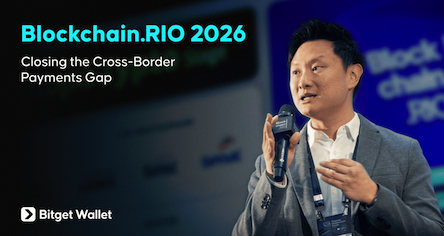
Pix is so widely used in Rio that everyday payments often feels effortless. A quick tap or scan is usually all it takes. We spent August 12 and 13 at Blockchain.RIO 2026 as a Platinum Sponsor, joining conversations about what happens the moment that same money needs to cross a border, panel sessions on our stage, to even a soccer game. Using money for everyday finance abroad should feel as easy as using Pix at home.
What we brought to the stage
Our COO, Alvin Kan, opened the conference on the Crypto Stage with a session on how crypto wallets are becoming Latin America's financial infrastructure. His point was simple: instant payments are already a daily habit across the region, but that speed usually stops at the border. Freelancers working with overseas clients, families sending remittances, and savers in Argentina and Bolivia trying to protect their money from currency depreciation all need something that works the same way no matter where the money is coming from.
Our Head of Business Development, Jasonn Ng, joined a Main Stage panel on Bitcoin, self-custody, and global adoption. Another team member Federico Garcia spoke on the StableCon Brasil Stage about custody and institutional security for stablecoins and wallets. Three stages, one thread: a wallet only earns its place in someone's daily life if it can move money as easily as the systems they already trust.
One wallet, every local rail
Bitget Wallet converts more than
100 currencies into stablecoins and connects to more than
300
financial institutions and
130 blockchains worldwide, with zero or reduced fees. That means you can reach the local instant payment systems people already use across Latin America, including Pix in Brazil, Transferencias 3.0 in Argentina, SPEI in Mexico, and Bre-B in Colombia, all from the same account.
You do not need a CPF, Brazil's taxpayer ID, to pay through Pix by QR code on Bitget Wallet, and the same holds for the local requirements in other markets. Blockchain technology keeps these transactions transparent and secure even where regulations differ from country to country. This is not only a Latin America story either: in parts of Southeast Asia, a digital wallet can help you avoid card fees that run as high as 4% of a purchase, simply by giving you a lower-cost local way to pay. All of it runs on the
Onchain Payments Matrix, our infrastructure layer that coordinates blockchains, stablecoin issuers, card networks, and merchants into one system, so a payment takes whichever path gets it there fastest.
Spending that grows with you
We also talked about
assetback, a recently launched feature on the
Bitget Wallet Card that lets you earn rewards in Bitcoin, tokenized gold, NYSE-listed stocks, or stablecoins on your everyday purchases. It is where we think spending is headed, tokenized assets built into the loop of daily transactions, so paying for something and building a portfolio become one experience instead of two.
On the ground at booth
Off the stage, we turned the same idea into a game at our booth. Under the banner "Break the barrier, the ball is in your court," attendees stepped up for a few shots at goal, with merch awarded based on how many they scored. You did not need to be a striker to walk away with something either. Those who downloaded the Bitget Wallet app, applied for a card, made a Pix transaction with Bitget Wallet, or simply followed us on social media, each unlocked a gift.
It was a fitting way to spend time in a city that already moves money at the speed we are building toward everywhere else. We left Rio with new conversations, new partners, and the same goal we walked in with – everyday finance, powered by crypto.
Visit
Bitget Wallet to learn more about the
Onchain Payments Matrix and how it connects stablecoins to the payment rails you already use.
 2026-08-17
 Bitget Wallet at Coinfest Asia 2026: Panels, Pins, and a Bali Sunset
Recommended