The "Dollar" Left America 70 Years Ago: Study How the Controls over it Have Shifted with Stablecoins
Some people argue the real global reserve currency was never the dollar itself, but the eurodollar. The name started as the telex address of a single bank and ended up describing every dollar held outside the United States.
Seventy years ago, the Soviet Union and Eastern European states wanted to keep their dollar accounts out of American hands, where they could be frozen. So they parked those dollars at Banque Commerciale pour l'Europe du Nord in Paris and Moscow Narodny Bank in London. The Paris bank's telex address was "Eurobank," and the eurodollar got its name. But it was Britain that turned these offshore dollars into a real credit market.
After the 1956 Suez crisis, Britain tightened its exchange controls, and London bankers began lending out these offshore dollar deposits instead. The eurodollar credit business was born. By 1957, the Bank of England loosened its stance further, and London became the center of the eurodollar market.
The surprising part is that the biggest force behind the eurodollar's explosion was the United States itself. Domestic deposit rates were too low, so offshore dollars had no reason to come home. When the oil crises hit in the 1970s, most of the dollar profits earned by oil producers never returned either. They stayed put, deposited in London and other offshore banks.
The eurodollar market grew from a few million dollars into the trillions. From that moment, the "eurodollar" no longer belonged to Europe.
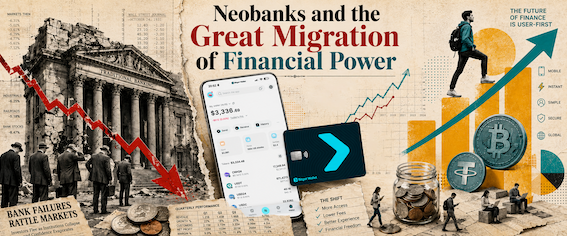
The story runs along two parallel threads. On one, the institutions carrying the dollar's credit keep changing hands, from a bank's ledger, to a fintech company's database, to a stablecoin issuer's reserve sheet. On the other, the relationship between users and their accounts quietly shifts too, from handing your money entirely to an institution, to holding control of your assets yourself.
Three things ran through both threads and never changed in seventy years. The dollar can keep expanding outside America; its final settlement always runs back through America; and whoever manages your account is not necessarily whoever actually promises to pay you.
Put another way, the question of "who owes you a dollar" never went away, but the answer kept changing. This is the story of how that one question wound its way through two migrations, right up to today.
I. The dollar leaves America
The moment those deposits moved to London, something easy to overlook happened. The bank that owed the money used to be in New York. Now the bank that owed it was in London. The currency stayed the same, but the party backing it had changed.
If that were the whole story, it would end here. But London banks soon discovered something more interesting. They could not only take dollar deposits; they could conjure up new dollars around them, out of thin air.
When a bank makes a dollar loan to a company, its asset side gains a claim on the borrower, and its liability side gains a new dollar deposit at the same time. That deposit can immediately be spent on a supplier's invoice, on equipment, or to pay off other debt.
Milton Friedman, the leading voice of monetarism, later put it beautifully. The source of eurodollars was not a printing press; it was "a bookkeeper's pen."
The bank did not create wealth from nothing. It was playing an old game of credit. As long as the market accepts the promise to pay, the dollars written on a ledger can be used like real dollars. That pen proved something for the first time: the thing carrying the dollar did not have to be a bank inside America.
What truly fed this market was a regulatory wall. America's Regulation Q capped the interest banks could pay depositors. London banks faced no such wall, so they could offer higher rates and win the business.
The economic historian Catherine Schenk, digging through British archives, found that in June 1955, because it could pay a good bit more than its American peers, London's Midland Bank took in around $49 million in 30-day dollar deposits in a single month.
After the 1957 sterling crisis, Britain also barred its own banks from using pounds to finance third-country trade, so London banks pivoted wholesale to dollar business. Companies and governments looking to raise money began to bypass New York and go straight to London.
The world's appetite for dollars kept growing while America's own banks were tied down. That gap fed an entire dollar market that could circulate and expand on its own, outside America.
Around 1960 the market was roughly $1 billion; a decade later, close to $50 billion. The 1973 oil crisis funneled oil producers' enormous dollar earnings back through London into the banking system. By 2007, offshore dollar deposits had climbed to about $8.9 trillion, more than 150% of deposits at American domestic banks. Today the Bank for International Settlements counts more than $14.3 trillion in dollar credit outstanding to non-bank borrowers outside the United States.
The dollar stopped being one country's business long ago. But from the moment it was born, the eurodollar carried a paradox it could never shake.
London banks could create dollar deposits; they could not create Federal Reserve reserves. They could write "I owe you a dollar" on a ledger, but the moment that promise had to be turned into actual cash, or the market suddenly tightened, they still had to turn back to their American correspondent banks and the American clearing system.
Dollar credit walked out of America's banking system for the first time, but it never once walked out of America's clearing system. That distinction only shows its true face in a crisis.
II. Three crises, three layers of power
In normal times, a dollar in cash, a dollar in a New York bank account, and a dollar in a London bank account all look identical. Nobody stops to wonder who actually backs each one, or how many systems it has to pass through before it truly lands in your hands. A crisis is the only thing that peels back that skin.
Clearing power: "I owe you" is not the same as money in the account.
June 26, 1974. New York, morning.
A group of traders on the floor did not yet know that the dollars on their books would never arrive. Hours earlier, they had done a currency trade with Germany's Herstatt Bank. The marks had already been delivered in Frankfurt, and now they were just waiting for New York to send the matching dollars.
Because of the time difference, afternoon in Germany was morning in New York. And in the German afternoon, regulators ordered Herstatt shut on the spot. What the New York traders got was not their money, but a bank that no longer existed.
Only then did they understand: what they held was a promise, "I owe you," never the money itself. Between the promise and the payment sit counterparties, correspondent banks, time zones, and clearing systems. If any link in that chain collapses, a right on paper does not automatically become a spendable dollar.
This episode later gave rise to the Basel Committee on Banking Supervision, and left a name still used today: Herstatt risk.
It laid bare the most basic layer of power in the eurodollar system. Being able to issue a dollar payment promise does not guarantee the money will actually arrive. Whoever controls clearing is who truly has the final say.
Lender-of-last-resort power: money on the books is not the same as money you can borrow
In 2008, European bankers found themselves in a strange spot.
On paper, they were sitting on piles of dollar assets, American mortgage securities, corporate bonds, all kinds of dollar-denominated paper. But behind those assets, there was no stable base of dollar deposits. Everything was rolled over on short-term funding, money market funds, commercial paper, interbank lending, kept alive like walking a tightrope.
In normal times this was cheap, as long as the borrowing channels stayed open. After Lehman fell, the market began to doubt whether anyone's assets were worth anything, and short-term lenders stopped rolling over all at once.
Overnight, these European banks held trillions in dollar assets but could not scrape together the cash to repay maturing liabilities. The world fell into a "dollar shortage."
An awkward question faced everyone: these banks were not in America and were not the Fed's responsibility, so who would send them dollars?
The answer, again, was the Federal Reserve. Through central bank swap lines, the Fed lent dollars to foreign central banks, which passed them on to local banks. In December 2008, swap balances briefly hit about $583 billion, a quarter of the Fed's total assets at the time. When the pandemic struck in 2020, the same mechanism was switched back on, with balances approaching $450 billion.
The truth was fully exposed. Offshore banks could create dollar deposits by lending, but they could not create the "hard dollars" used for real settlement and repayment.
When everyone tries at once to turn a bank's promise into top-grade real money, only the Fed can backstop it all. That is the second layer of power: the lender of last resort. Whoever can backstop a crisis is the system's true anchor.
Pricing power: whoever calls the number wins half a century
London bankers quietly held a third thing.
The funding costs London banks reported for themselves evolved into LIBOR, the pricing benchmark for loans, bonds, and derivatives worldwide. At its peak, financial contracts tied to it ran into the hundreds of trillions of dollars.
London banks could not only create dollars outside America; they had taken something even more powerful, the power to price dollar funding for the whole world.
But this pricing mechanism had a fatal flaw. It relied on numbers banks "reported" themselves, not on real transactions. When the scandal broke, that flaw was fully exposed. Barclays alone paid $450 million in fines to American and British regulators for manipulating its quotes.
After trust collapsed, a spoken LIBOR gave way to SOFR, built on real repo transactions. In June 2023, the US dollar LIBOR panel shut down for good. The eurodollar did not disappear, but the era of London banks calling the shots was over.
Herstatt, the dollar shortage, and the end of LIBOR each tore open one of these hidden layers, clearing power, lender of last resort, and pricing power. Offshore banks gained the ability to expand dollar credit, but they never truly gained final control of the system.
And the financial innovation that came next did not change that power structure first. It changed the thread closest to ordinary people: the relationship between you and your dollar account.
III. The dollar account moves into your phone
Over the past decade or so, fintech's greatest success was compressing an entire bank branch's paperwork into a phone app. Opening an account, converting currencies, sending money across borders, things that once meant visiting a branch, filling out forms, and waiting days, now take minutes.
The entrance to a dollar account moved from the teller window into a software interface.
Revolut and Wise are the standard-bearers of this generation, and they look like twins. Both let you hold multiple currencies, convert, send money across borders, and spend on a card, and most people cannot tell them apart in daily use. But the legal structures behind the numbers in each app are completely different.
Revolut chose the "become a real bank" path. In 2018 it obtained a Lithuanian banking license, letting it offer banking services across several European countries, where eligible deposits become genuine bank deposits protected by local deposit insurance.
In 2026, it began bringing UK users in gradually through a British banking entity. The result is that the same app can hold balances that are not the same thing at all across regions and legal entities; some are already protected bank deposits, some are still e-money, and some are just client funds held by a partner institution.
Wise took a different path. It is more like an "e-money machine" that does not broadly turn users' money into deposits it takes onto its own books.
The balance you see in Wise is a promise of e-money that Wise owes you, and the client funds behind it must be held separately from Wise's own money. If Wise fails, in principle you can recover your money from that segregated pool ahead of other creditors, but whether you get it all back, and how fast, depends on how clean the records are and how smoothly local insolvency proceedings run.
One leans closer to a traditional bank, backstopped by heavier regulation and deposit insurance; the other avoids bank-style credit expansion and holds up its promise by segregating funds.
The difference comes down to who provides the backstop, how the money is held, and which path a user takes to recover funds if the platform shuts down.
But the two share one thing. The account record always sits in the institution's own database. You can tap a button in the app to start an action, but opening an account, freezing it, transferring, and withdrawing all come down to the institution's system in the end.
What you hold is a contractual right, not direct control over the underlying funds. Traditional fintech moved the dollar account from the teller window into your phone, but it never touched the question of who holds custody.
It redesigned the entrance without redistributing control. That is exactly where the stablecoins and self-custodial wallets that come next matter.
IV. Stablecoins: The dollar leaves the closed account for a borderless ledger
The real breakthrough of stablecoins is not that they created a risk-free money. It is that they changed how the dollar's payment promise exists and moves.
Banks and e-money institutions keep their records in their own internal ledgers. You can open an app and check the balance anytime, but to move the money, it still has to pass through the institution's system.
Stablecoins seal the dollar's redemption promise into a token you can hold and transfer directly on a public blockchain. What you hold is no longer a line in some institution's database; it is an asset that moves freely between wallets, exchanges, and onchain protocols.
The eurodollar moved dollar credit from New York's ledger to London's ledger; stablecoins go one step further, moving the dollar balance out of any single institution's ledger and onto a public ledger no one owns outright.
To be precise, stablecoins split "one dollar" into two things: redemption and transfer.
The redemption half is not new at all. The issuer backs the promise with reserve assets, mostly US Treasuries and bank deposits, held at traditional financial institutions, with final redemption still running through traditional channels. That half never left the old world.
The genuinely new thing is the transfer half. For the first time, a dollar balance can change hands directly on a public ledger, free of any single institution's internal system.
Stablecoins are not "dollars without banks"; they are dollars whose redemption stays in traditional finance while transfer moves onto a public ledger.
The force behind both the eurodollar and stablecoins is the same. Global demand for dollars has always been far larger than the range traditional banks are willing to serve cheaply.
Ordinary people in high-inflation countries want to hold their purchasing power; companies doing cross-border business need to settle invoices; migrant workers need to send money home. They are not completely cut off from dollars, but they keep getting blocked by exchange controls, account-opening hurdles, steep fees, and slow reviews.
Demand does not vanish because traditional finance cannot meet it. It just looks for a new outlet. In the 1950s, that demand found London's banks. Today, it found stablecoins, and a borderless public ledger.
But at its core, the stablecoin still carries the eurodollar's old double nature: it circulates globally, yet ultimately connects back to America's financial system.
In the reserves behind mainstream stablecoins, the bulk is US Treasuries and bank deposits. The token can run onchain all over the world, but reserve custody, asset management, and final redemption stay firmly bound to traditional financial infrastructure.
Seen from another angle, stablecoins do not weaken the dollar system at all. They lay a larger global distribution network for US Treasuries and dollar assets.
That network is no longer a small business. As of July 2026, stablecoins had a total market value of about $312 billion and settled around $33 trillion onchain over the course of 2025. The largest issuer, Tether, held roughly $141 billion in US Treasury exposure, which, ranked alongside sovereign nations, sits near the top twenty holders of US debt worldwide.
Stablecoins are not just a digital replica of the eurodollar, though.
The eurodollar relied on banks taking deposits and making loans, expanding their balance sheets while carrying the credit and maturity risk themselves. Mainstream stablecoins look more like a repackaging of dollar assets that already exist, redistributed as-is, with redemption backed by cash and short-term Treasuries.
The way they transfer is also completely different. The eurodollar had to route through correspondent banks and clearing networks; stablecoins can settle directly onchain. In the past, to hold offshore dollars, you first needed a bank account. Now an onchain address is enough.
And so regulation arrived. That is no surprise.
Look back at the second section: the three layers of the eurodollar's power were all clawed back one by one. Clearing risk gave rise to the Basel Committee; the dollar shortage made the Fed the backstop for the whole system; the death of LIBOR took pricing power away from London's banks.
Regulation never stops offshore dollars from being born, but it never lets them grow large enough to threaten the system without stepping in. The same script is now running fast on stablecoins.
The EU, Hong Kong, and the United States have passed laws in turn, defining who can issue stablecoins, what reserves must hold, and whether users can redeem at any time. America's 2025 GENIUS Act even wrote bankruptcy rules into law: when a compliant issuer fails, stablecoin holders come first in line to claim the reserve assets.
Consider that the holders of London's IOUs waited seventy years and never read anywhere in law where they stood in line. Stablecoin holders got that one line in just over a decade.
The arrival of regulation is this new dollar's coming of age.
V. Self-custody wallets: the account no longer belongs to a creditor
Banks, e-money institutions, and custodial platforms, however different, share essentially the same relationship with the user. You hand your assets to them first, they record a balance for you, and the service revolves around that balance.
Self-custodial wallets change something else: not who redeems the dollar, but the control relationship between the user and the asset.
A self-custodial wallet like Bitget Wallet does not take your deposit, does not create a platform balance for you in its own ledger, and does not owe you any stablecoin.
The asset is recorded on the blockchain, and to move it, the private key must sign. The wallet provides address generation, key management, transaction signing, onchain connectivity, and access to financial services, but it is not a creditor holding your assets for you.
This changes how financial services are organized.
In the past, you first became a client of some institution and put your money in an account it managed, and only then could you use payments, trading, and earning services.
Now you can own and control your onchain assets first, then connect to those services through a wallet. The address does not depend on any one wallet company; as long as you hold the private key, you can open the same address in a different wallet app.
So self-custody solves "who can move this money," while the stablecoin issuer solves "who ultimately redeems it."
Whether the reserves are adequate, whether the issuer can redeem, whether regulators approve, still comes down to the issuer and the legal structure.
The wallet solves a different layer of risk: whether you must hand control of your assets to a platform in order to use financial services.
This is the fundamental line between self-custodial wallets and every financial account before them. Financial services and asset custody are split apart for the first time.
Payments, trading, yield, and asset management can sit in the same entrance, but transfer control over the asset need not be handed over.
The redemption responsibility behind the dollar still sits with the issuer, but transfer control over the account can, for the first time, stay in the user's hands.
Over seventy years, the dollar went through two intertwined migrations.
One happened in who carries the dollar's credit. The eurodollar proved banks outside America could create dollars; fintech companies repackaged the dollar account into a globally usable software product; stablecoin issuers sealed the dollar's payment promise into a token that circulates on a public ledger.
The other happened between users and their accounts. Revolut and Wise changed how ordinary people reach dollars, but the account always stayed under institutional management; stablecoins broke free of the single bank account, yet could still be locked inside a custodial platform; self-custodial wallets, for the first time, let you use a full stack of financial services without first surrendering control of your assets.
Conclusion: where the two migrations meet
Seventy years ago, the dollar flowed from New York's ledger to London. Later it slipped into fintech databases, and then, in the shape of a stablecoin, reached a public ledger.
The ledger changed again and again, and the institutions carrying it changed batch after batch, but the promise behind the dollar never disappeared.
The real change happens in the last step. When a stablecoin moves into a self-custodial wallet, you still have to trust the issuer to honor its promise, but you no longer need to hand the money to another platform to hold for you.
The credit relationship remains; control, for the first time, can stay in your own hands.
The dollar never escaped its debtor. It is just that this time, the account no longer has to belong to the debtor.
 2026-08-14