


What Is a Cross-Chain Swap? How to Swap Tokens Across Blockchains
Key Takeaways
- A cross-chain swap lets you trade tokens across different blockchains in one transaction flow.
- For example, you can swap ETH on Ethereum for USDC on Base.
- In Bitget Wallet, same-chain swaps, cross-chain swaps and bridge routes are available from the Trade screen.
- Unlike a crypto bridge, a cross-chain swap can change both the token and the network.
- Review the selected tokens, networks, estimated receive amount and fees before confirming.
A cross-chain swap is a way to trade crypto across chains. It lets you exchange a token on one blockchain for another token on a different blockchain without manually completing a separate bridge transaction first.
For example, if you hold ETH on Ethereum and want to receive USDC on Base, Bitget Wallet can provide an available cross-chain trading route through one quote and one confirmation in the Trade screen.
Explore Cross-Chain Swap in Bitget Wallet
What Is a Cross-Chain Swap?
A cross-chain swap, also called a cross-chain token swap, is a transaction that lets you trade one crypto asset for another across different blockchain networks.
With a same-chain swap, both tokens are on the same network. With a cross-chain swap, the token you sell and the token you receive are on different chains.
Examples of cross-chain trading include:
- Swapping ETH on Ethereum for USDC on Base;
- Swapping USDT on Robinhood for a token on HyperEVM;
- Swapping USDT on Base for an USDC on Morph.
A cross-chain swap may use decentralized exchanges, liquidity providers, bridges, smart contracts or other cross-chain infrastructure in the background. The available route depends on the selected tokens, networks, liquidity and current market conditions.
How Is a Cross-Chain Swap Different From a Same-Chain Swap or Crypto Bridge?
Same-chain swaps, cross-chain swaps and crypto bridge routes can all be accessed from the Trade screen in Bitget Wallet. The main difference is what you want to receive.
When Should You Use a Same-Chain Swap?
Use a same-chain swap when you want to trade tokens but stay on the same blockchain.
For example, if you hold USDC on Base and want ETH on Base, you can swap USDC for ETH without leaving the Base network.
When Should You Use a Cross-Chain Swap?
Use a cross-chain swap when you want to trade a token and receive a different token on another blockchain.
For example, if you hold ETH on Ethereum and want USDC on Base, a cross-chain swap can handle the token trade and the cross-chain route in one flow.
When Should You Use a Crypto Bridge?
Use a crypto bridge when you want to move the same asset between networks.
For example, if you hold USDC on Ethereum and want to use USDC on Base, a bridge can move USDC from Ethereum to Base without changing it into another token.
Some cross-chain swaps may use bridge infrastructure in the background. The difference is the intended result:
- A same-chain swap changes the token but stays on the same network.
- A cross-chain swap changes both the token and the network.
- A bridge changes the network but keeps the same asset.
How Do You Do a Cross-Chain Swap in Bitget Wallet?
You can access available cross-chain swap routes from the Trade screen in Bitget Wallet.
- Open Trade in Bitget Wallet.
- Select the token and source network you want to trade from.
- Select the destination network and token you want to receive.
- Enter the amount and review the exchange rate, estimated receive amount and fees.
- Check that your wallet balance is sufficient to complete the transaction.
- Tap Confirm to submit the cross-chain swap.
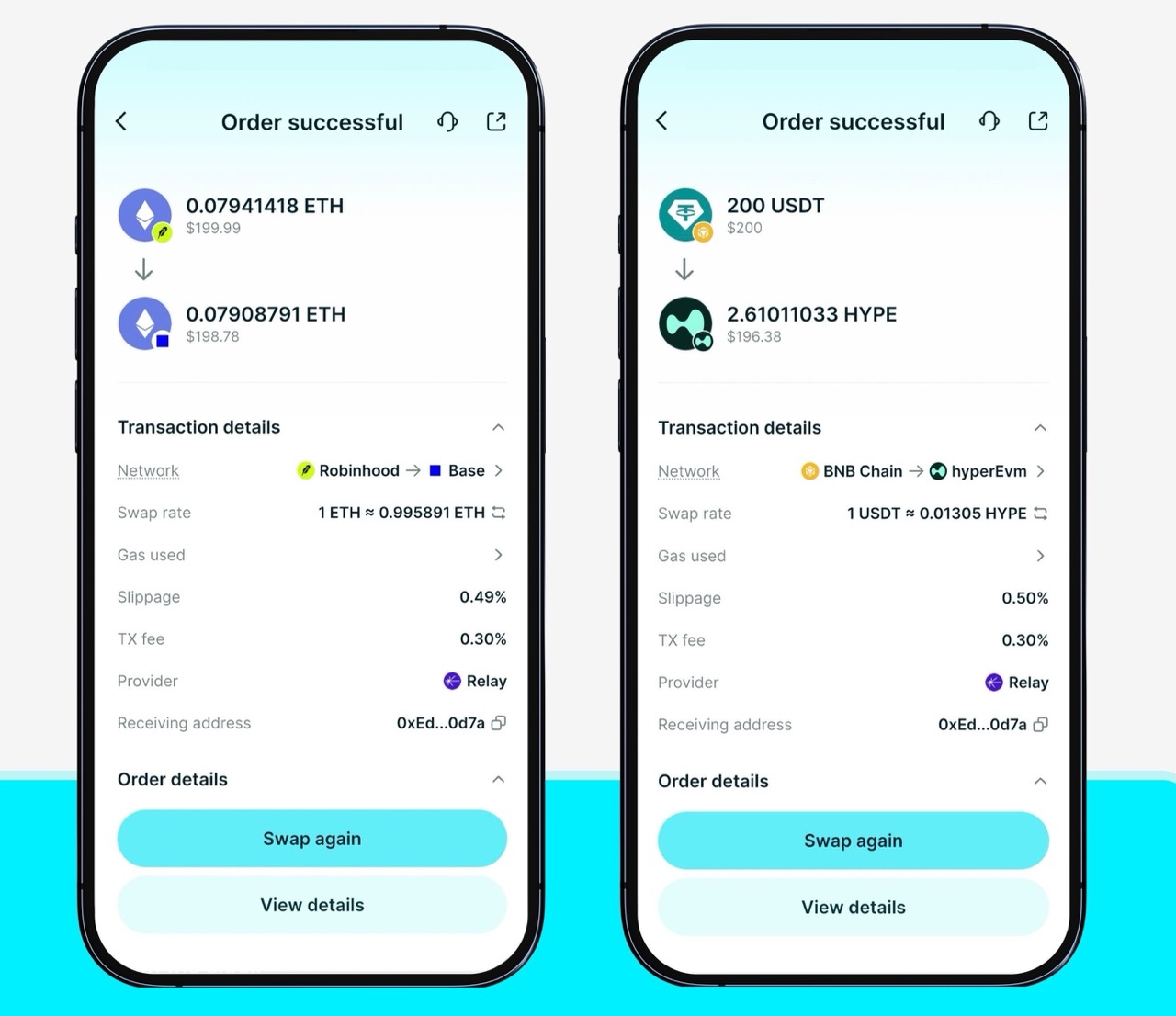
Before confirming, review the source network, destination network, selected token, estimated receive amount and fees.
Cross-chain swaps can take longer than same-chain swaps because the transaction may involve more than one blockchain.
For full instructions and route examples, read How to Swap Tokens on Bitget Wallet: A Beginner’s Guide
What Should You Check Before a Cross-Chain Token Swap?
Before you swap tokens across blockchains, check the following:
- Source network: Confirm where your current token is held.
- Destination network: Confirm where you want to receive the destination token.
- Selected token: The same token symbol may exist on multiple networks.
- Estimated receive amount: Review the quote, fees, slippage and price impact.
- Wallet balance: Make sure your available balance is sufficient to complete the transaction.
- Route availability: Some token and network combinations may not have an available cross-chain route at all times.
If you are using a new network, token or cross-chain swap route for the first time, consider starting with a small amount.
What Can Affect a Cross-Chain Swap?
Most cross-chain token swaps can be completed through the route shown in the quote. However, a few factors may affect the final amount received or transaction completion time.
- Wallet balance: The transaction may not proceed if your available balance is insufficient.
- Quote and slippage: Token prices and liquidity can change, which may affect the estimated receive amount.
- Route availability: Available cross-chain routes may change based on supported networks, liquidity providers and market conditions.
- Completion time: A cross-chain transaction may take longer than a same-chain swap because it can involve more than one network.
Bitget Wallet displays the transaction quote before confirmation. Review the details carefully before submitting.
Why Did My Cross-Chain Swap Fail?
A cross-chain swap may fail when:
- your available balance is insufficient to complete the transaction and estimated fees;
- the quote has changed or slippage is too high;
- the selected token pair has limited liquidity;
- the selected cross-chain route is temporarily unavailable.
Check the transaction status in Bitget Wallet before trying again. For additional support, see the relevant Cross-Chain Swap Help Center guide.
Frequently Asked Questions
What is a cross-chain swap?
A cross-chain swap is a way to trade a token on one blockchain for another token on a different blockchain. For example, you can swap ETH on Ethereum for USDC on Base.
Is a cross-chain swap the same as a crypto bridge?
No. A crypto bridge usually moves the same or equivalent asset between blockchains. A cross-chain swap trades one asset for another across different networks.
Where can I make a cross-chain swap in Bitget Wallet?
You can access same-chain swaps, cross-chain swaps and bridge routes from the Trade screen in Bitget Wallet.
How long does a cross-chain swap take?
Transaction time depends on the selected networks, route, liquidity and current network conditions. Cross-chain swaps may take longer than same-chain swaps.
Can I cancel a cross-chain swap?
Once an on-chain transaction has been submitted and confirmed, it usually cannot be canceled. Review the selected token, networks, amount, fees and estimated receive amount before confirming.
Conclusion
A cross-chain swap is a practical way to trade crypto across blockchains.
In Bitget Wallet, you can access same-chain swaps, cross-chain swaps and crypto bridge routes from the same Trade screen. Select the token and network you want to trade from, choose the token and network you want to receive, review the quote and confirm when the transaction details look correct.
Risk Disclosure
Please be aware that cryptocurrency trading involves high market risk. Bitget Wallet is not responsible for any trading losses incurred. Always perform your own research and trade responsibly.

 Arc Wallet Guide: How to Get Started With Arc in Bitget Wallet2026-09-19 | 5 mins
 What Is a Crypto Bridge? How to Move Crypto Between Blockchains2026-09-04 | 3 mins



