Ten years on, why aren't you any richer?
Product

Over the past ten years, you've probably done everything you were supposed to. You got a promotion, earned a raise, and became more intentional about how you spent your money. You learned which credit card gave the best cashback, hunted for discounts, and found small ways to save on everyday purchases.
Yet convert today's salary into what it could have bought a decade ago, and something uncomfortable emerges. Your income is higher and your account balance has grown, but the same house deposit, family holiday, or dinner that once felt "a little expensive but manageable" has quietly drifted further out of reach.
This isn't a failure of budgeting, nor is it a trick of memory. It's the result of how modern monetary systems are designed to work. For decades, most major central banks have targeted around 2% annual inflation, meaning the purchasing power of cash is expected to decline over time. Not because policymakers failed, but because they largely consider it a feature rather than a flaw.
That raises a different question. If we had understood these rules ten years ago, and chosen to store our wealth in assets instead of cash, how different would our financial position look today? This article works through that question.
2%, a promise to devalue, hidden in plain sight
Most people think of inflation as an economic problem that appears from time to time – a consequence of wars, supply shocks, or poor policymaking. The history of modern monetary policy tells a different story. Over the past three decades, central banks have increasingly converged on the idea that low, stable inflation of around 2% is not only acceptable, but desirable.
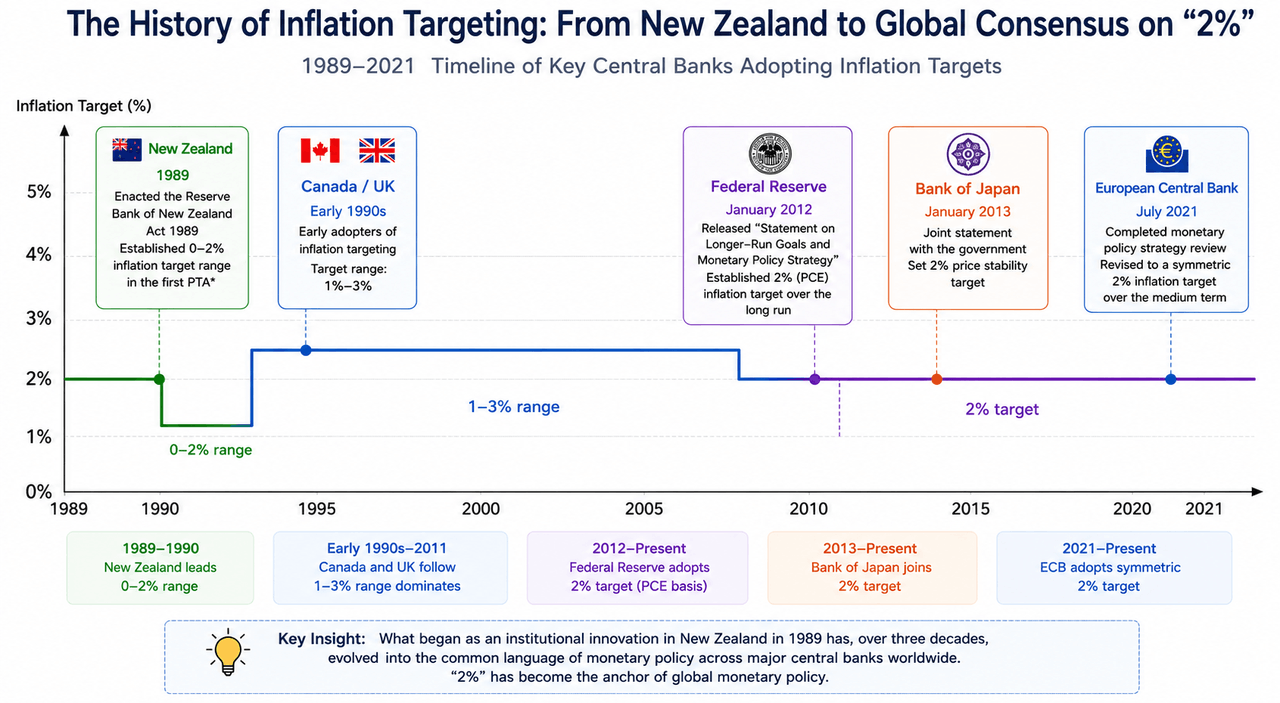
The turning point came in New Zealand. Following the high inflation of the 1970s and 1980s, New Zealand introduced one of the world's first inflation-targeting frameworks through the Reserve Bank of New Zealand Act 1989. In
1990, its first Policy Targets Agreement established a CPI target of 0–2%, making New Zealand widely regarded as the birthplace of inflation targeting.
The framework spread quickly. Canada, the United Kingdom and Sweden adopted similar approaches in the early 1990s. Over the following two decades, the world's largest economies followed:
-
In 2012, the US Federal Reserve formally adopted a 2% longer-run inflation objective, the first explicit target in its nearly century-long history.
-
In 2013, the Bank of Japan established a 2% price stability target as part of Abenomics.
-
In 2021, the European Central Bank replaced its previous "below, but close to, 2%" wording with a symmetric 2% target.
Today, despite vast differences in their economies, most major central banks share the same objective: preserve price stability by allowing prices to rise modestly over time.
Why central banks think they have little choice
At first glance, deliberately allowing money to lose purchasing power every year sounds counterintuitive. Why would policymakers aim for inflation instead of eliminating it altogether? From a central bank's perspective, the answer comes down to three practical constraints.
1. Avoiding deflation
While falling prices may sound appealing to consumers, persistent deflation changes behaviour. If households expect goods to become cheaper tomorrow, they delay spending. Businesses invest less, demand weakens further, and prices continue falling. Japan's "Lost Decades" remain the clearest illustration of how difficult this cycle can be to escape.
2. Wage rigidity
In practice, employers rarely reduce employees' nominal wages. Doing so damages morale, increases staff turnover, and often creates legal or contractual complications. Moderate inflation provides a quieter adjustment mechanism: wages stay broadly unchanged while their purchasing power gradually declines.
3. Preserving room for monetary policy
Interest rates can only fall so far before reaching zero. If long-term inflation were also zero, interest rates would tend to remain near zero during normal times, leaving central banks with few conventional tools when recessions arrive. A positive inflation target keeps nominal interest rates higher, giving policymakers room to cut them when the economy slows.
Whether one agrees with this framework or not, the logic is internally consistent. Inflation is not treated as an unintended consequence of monetary policy. It is one of its primary instruments.
The cruelty of compounding
The problem isn't that inflation averages around 2%. It's that inflation
compounds. Two percent sounds almost insignificant in any given year. Over decades, it becomes anything but.
At a steady annual inflation rate of 2%:
-
After 10 years, prices are roughly 22% higher, reducing purchasing power by around 18%.
-
After roughly 35 years, the purchasing power of money is cut in half.
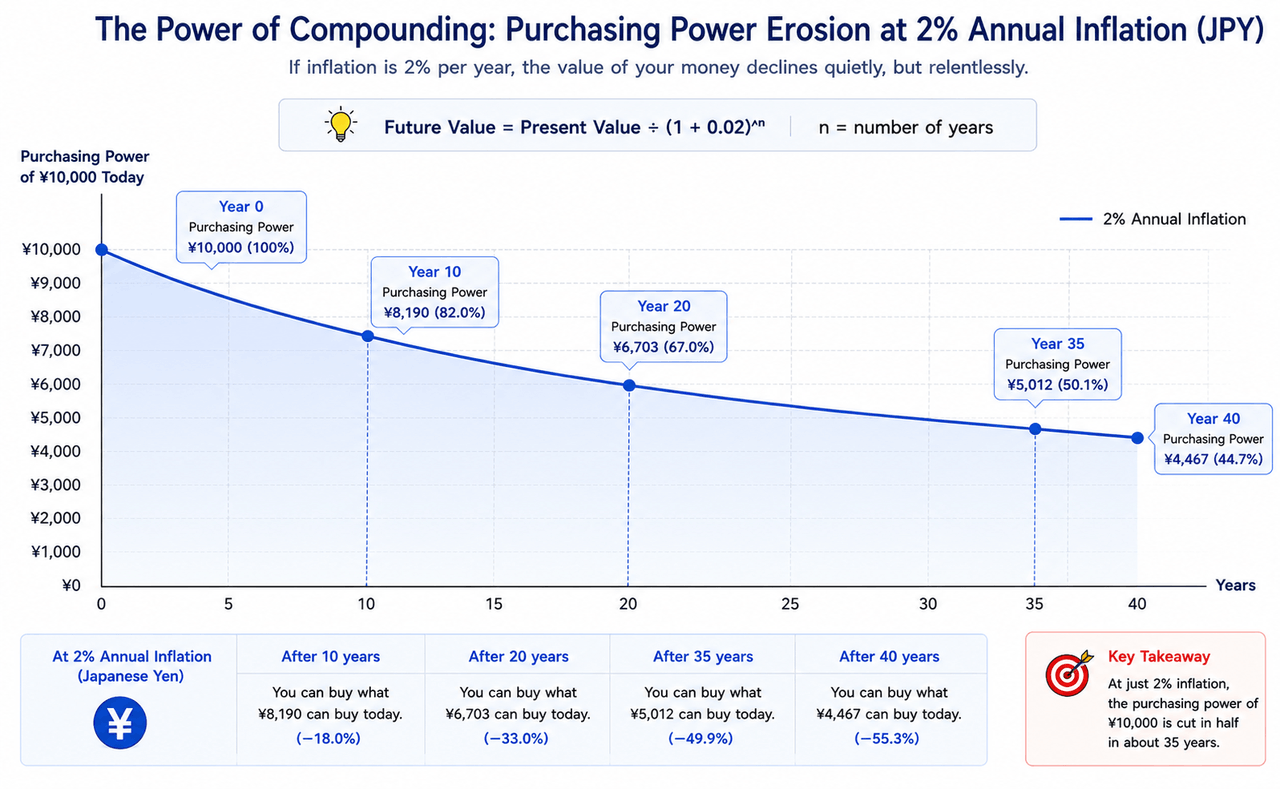
That is the real weight of the 2% contract. Cash isn't sitting still while it waits in a savings account. Its purchasing power is gradually eroded every year, whether you notice it or not.
Reality, however, has often been harsher than the theory. The inflation shock of 2021–2023 pushed prices far beyond the long-run target across much of the developed world. US inflation peaked at 9.1%, while inflation in the eurozone reached 10.6%. Even after inflation moderated, the cumulative loss in purchasing power over the decade proved significantly larger than the "expected" 2% path.
In other parts of the world, the consequences have been even more severe. The Japanese yen experienced one of its sharpest declines in decades. The Turkish lira's prolonged depreciation became a case study in persistent inflation and unconventional monetary policy. Argentina's peso remains one of the clearest examples of how confidence in a currency can unravel altogether.
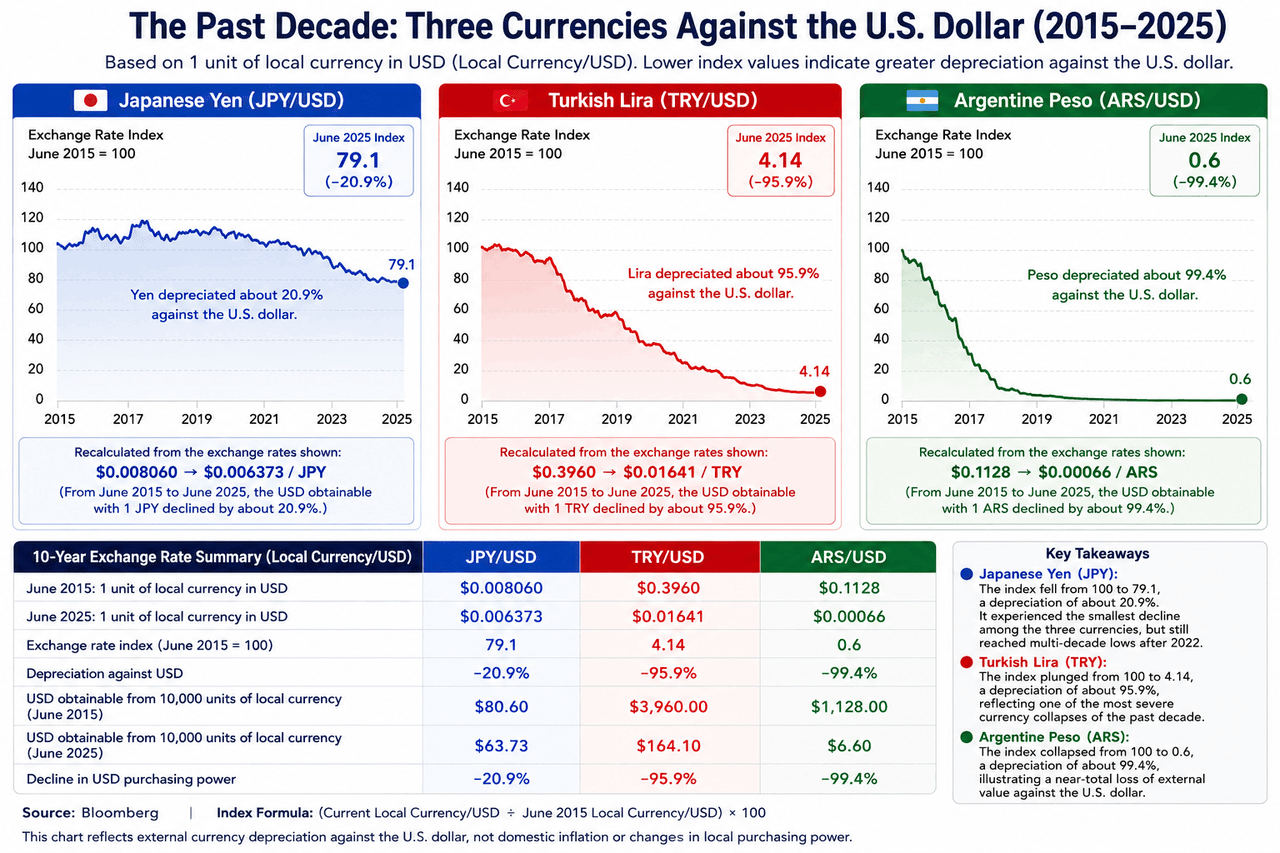
These examples serve as a reminder that the 2% target is exactly that – a target. It is not a guarantee. Its success depends on the credibility of the institutions pursuing it, and history shows that credibility can vary widely.
A promise, but no guarantee
This is where the logic becomes uncomfortable. Central banks may target 2% inflation, but
a target is not a guarantee.
When you lend money to a company, there is usually some form of protection. You may have collateral, contractual rights, or legal recourse if the borrower defaults. But when you hold your lifetime savings in fiat currency, none of those protections exist.
If inflation runs above target because of policy mistakes, external shocks, or political pressure, there is no mechanism to compensate you for the loss in purchasing power. You simply absorb it.
That asymmetry is easy to overlook because money serves three different functions: a unit of account, a medium of exchange, and a store of value. The first two are deeply embedded in the financial system. Your salary is paid in legal tender. Taxes must be settled in it. Mortgages, loans, and most contracts are denominated in it. In practical terms, you have little choice but to use your local currency for everyday life.
Storing long-term wealth is different. In most countries, there is no requirement to keep your savings in cash. You are free to hold gold, stocks, property, or any other asset you believe will preserve value more effectively.
Which raises an obvious question:
If cash is designed for spending rather than preserving wealth, why do so many people continue to treat it as their primary savings vehicle?
The answer isn't that
cash is the best store of value. The past decade has repeatedly shown that it isn't. The real reason is that moving from cash to assets has traditionally come with far more friction than most people are willing to accept.
Opening a brokerage account, passing compliance checks, understanding different asset classes, deciding what to buy and when to buy it – all of these require time, effort, and a level of financial confidence many people simply don't have.
The psychological barrier is just as important: For generations, "saving" has meant putting money in the bank. Buying assets, by contrast, feels like investing – and investing feels like taking risk. Most people don't consciously choose cash because they believe it will outperform other assets. They choose it because it feels familiar, simple, and safe. Ironically, that familiarity has become one of its greatest risks.
The past decade has shown that the biggest determinant of long-term wealth isn't simply how much you earn. It's where your savings spend their time. That is where the real divergence begins.
Three kinds of people, three outcomes
Enough theory. Suppose it's 2015. You have $100,000. You make no market calls, don't trade actively, and never try to time the cycle. You simply choose one place to keep your money and leave it there for the next ten years. How different would the outcomes be?
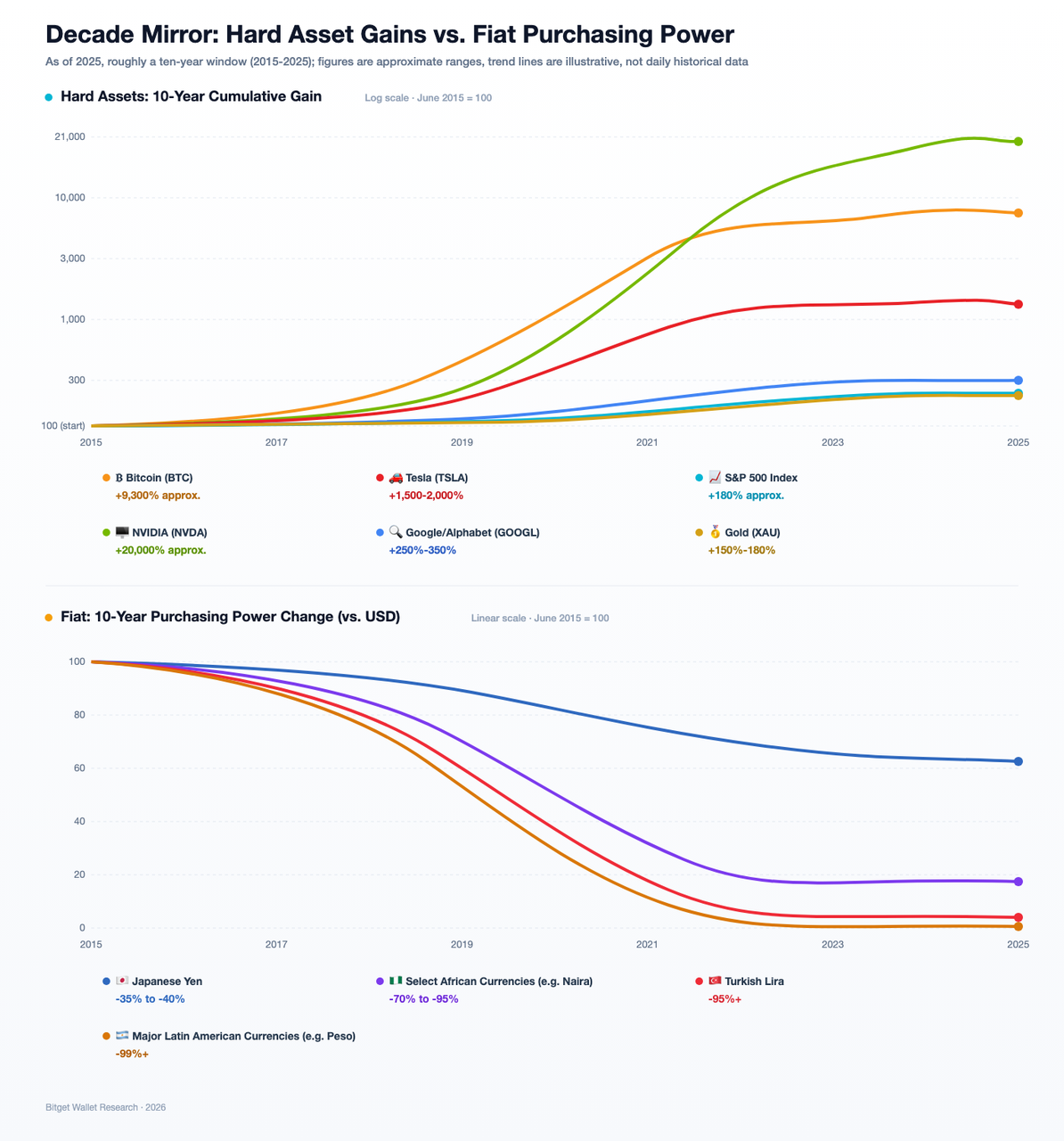
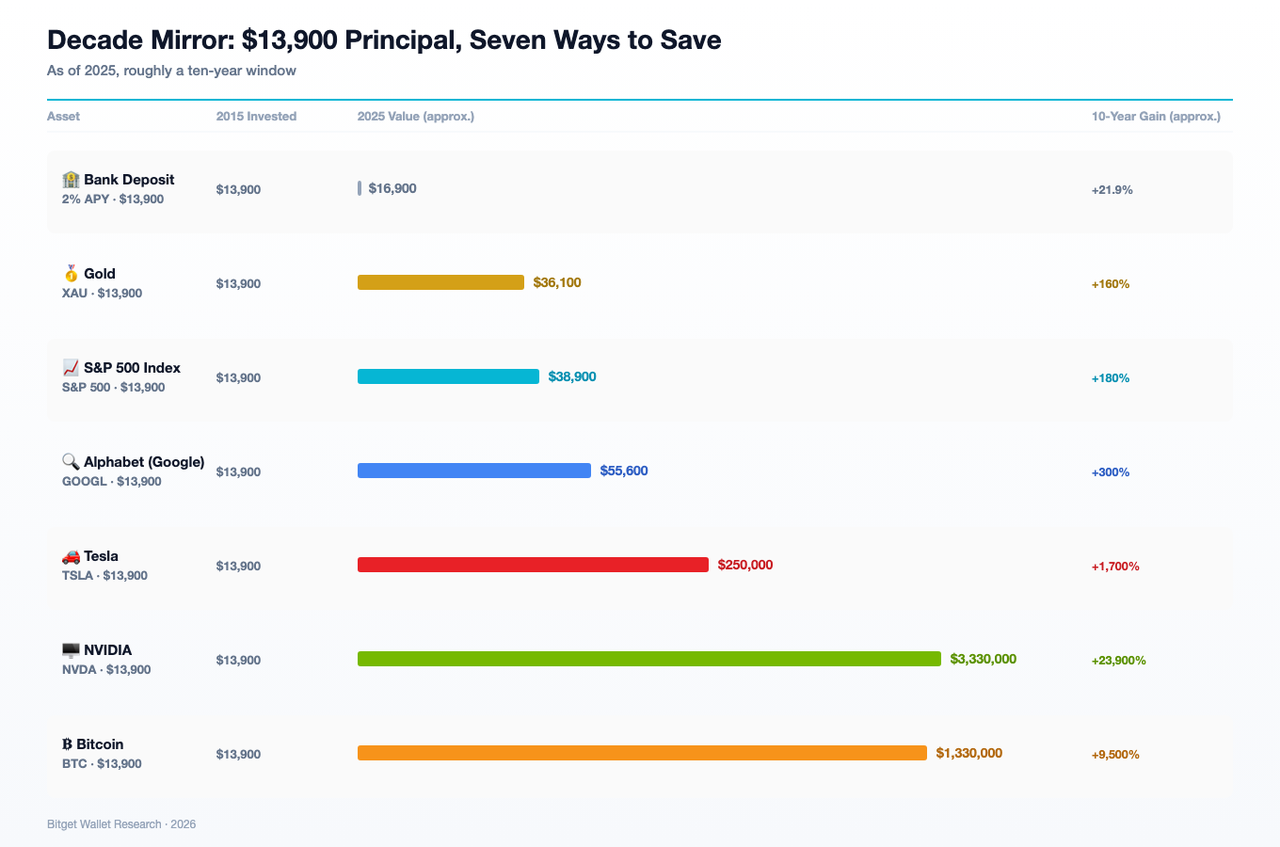
Over the past decade, many people chose the first path. They kept their money in savings accounts, fixed deposits, or money market funds. On paper, their wealth grew steadily. The number in the account increased every year.
But nominal returns tell only half the story. Once inflation is taken into account, much of those gains disappear. In years when inflation accelerated, purchasing power actually declined despite positive account balances.
This is perhaps the easiest mistake to make when thinking about wealth. We instinctively measure progress by the size of our bank balance, when what ultimately matters is what that balance can buy.
Translate the numbers into three real life choices and you get three trajectories:
Group A, the fiat savers: Diligent, careful, risk-averse. They put hard-earned money into bank fixed deposits or the "steady" money-market products their bank recommended. Over ten years the number in the account did climb slowly, and the nominal yield looked like it "beat" the savings account. But adjust for real purchasing power and a decade of effort barely offset the erosion of inflation, and in years when inflation ran hot, they took a net loss in real terms. They did nothing "traditionally wrong," and still had the hardest time in this ten-year game.
Group B, the asset holders: What they did was essentially very simple: turn idle fiat liquidity into gold, quality stocks, Bitcoin, and other hard assets as fast as they could, then hold for the long run without frequent timing. They weren't necessarily professional investors; many just "couldn't be bothered" to manage it, buying and then leaving it alone. That very "laziness" let them capture the enormous premium of the past decade's global asset-price expansion.
Group C, the altcoin speculators: The easiest to overlook, but just as important. They also tried to "escape fiat devaluation," but the vehicle they chose was altcoins with no real value support, driven purely by narrative and liquidity. Over the past decade, the fate of most altcoins was zero, or close to it. This group is a reminder: the direction, "escape fiat," is rational, but the choice of "escape to where" matters just as much. Not every "non-fiat asset" holds value by nature. An asset's scarcity, the strength of its consensus, and real demand are what decide whether it survives the cycle.
The most honest signal: watch what central banks buy
There's another way to think about this. Rather than asking what central banks say, look at what they do. Over the past several years, central banks around the world have been buying gold at the fastest pace in decades. According to the World Gold Council, official-sector purchases have remained near record highs, helping drive gold to successive all-time highs through 2025.
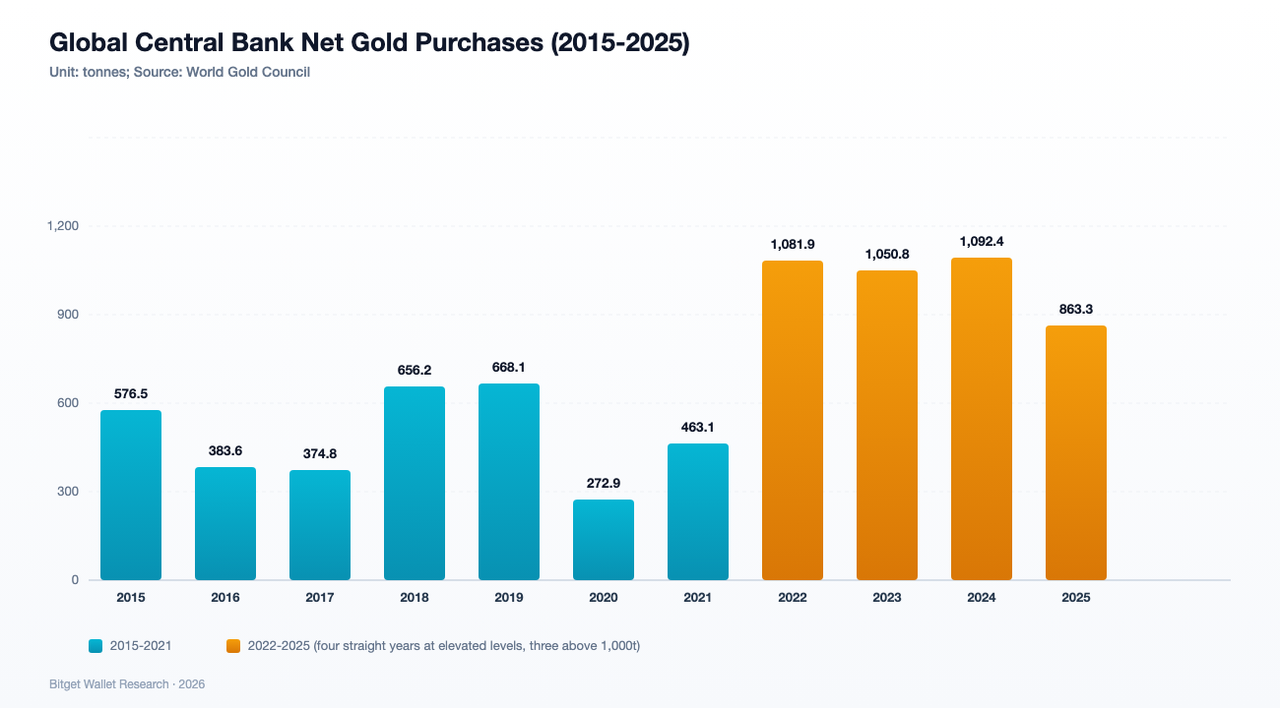
This isn't because central banks distrust the currencies they issue. They understand better than anyone that fiat money serves a different purpose. Currencies are designed to facilitate exchange. Gold is held as a long-term reserve asset. That distinction is telling. The same institutions responsible for managing fiat currencies diversify part of their own balance sheets into scarce assets. They do not rely exclusively on cash to preserve long-term value.
Whether gold, equities, Bitcoin, or other scarce assets ultimately perform best is a separate question. The broader point is harder to ignore: Even the institutions that issue money do not depend solely on money to store wealth.
If the answer is assets, why doesn't everyone own them?
At this point, the obvious objection is also the most reasonable one. Even if holding assets produces better long-term outcomes than holding cash,
most people aren't professional investors. They don't have the time to study markets, compare asset classes, or decide when to buy. For many, the problem isn't understanding inflation – it's that accumulating assets has always required far more effort than simply leaving money in the bank.
That's the part we often overlook. Saving has been designed to be frictionless. Your salary arrives, you leave it in your account, perhaps move part of it into a savings product, and you're done. Accumulating assets, by contrast, usually involves opening brokerage accounts, completing compliance checks, deciding what to buy, and living with the uncertainty of whether you've entered the market at the right time. The knowledge gap matters, but the convenience gap matters even more.
If that's true, then perhaps the real innovation isn't persuading more people to invest. It's reducing the operational friction until accumulating assets becomes as effortless as saving has always been.
From "stablecoin cashback" to "assetback"
For most of modern finance, spending and investing have been treated as competing choices. Every dollar spent was one less dollar available to invest, and building wealth required making a deliberate decision to set consumption aside. That distinction made sense when investing demanded time, knowledge, and active participation. But if asset accumulation can happen automatically alongside everyday spending, the trade-off begins to look different.
Imagine paying for your morning coffee, groceries, or flight while quietly accumulating a long-term asset position in the background. You haven't changed your spending habits or tried to time the market. Instead, the act of investing has been embedded into something you were already going to do. The shift may seem subtle, but it changes the role of financial products entirely. Rather than asking users to become better investors, they reduce the friction between earning, spending, and gradually building wealth.
References:
-
The inflation target range initially set by New Zealand’s Reserve Bank Act 1989 (0–2% or other ranges) – Source: Historical documents from the RBNZ official website
-
Original 2012 Federal Reserve statement and comparison of revisions over the years – Source: federalreserve.gov
-
Original 2013 joint statement by the Bank of Japan – Source: boj.or.jp
-
Original 2021 strategic review by the European Central Bank – Source: ecb.europa.eu
-
Verification of the precise figures for 10-year/35-year compound calculations at a 2% inflation rate
-
Annual actual inflation data and peaks over the past decade for the US and eurozone (e.g., 2022 CPI peak) – Sources: BLS, Eurostat/ECB
-
Precise 10-year depreciation rates of the Japanese yen, Turkish lira, Argentine peso, and Nigerian naira – Sources: IMF, central banks of respective countries, BIS
-
Precise 10-year gains of BTC/NVDA/TSLA/GOOGL/S&P 500/gold – Sources: TradingView, Macrotrends, official NASDAQ data, Yahoo Finance
-
Precise figures and statistical methodology behind the World Gold Council’s 2025 claims of “53 all-time highs” and “central bank gold purchases exceeding 5,000 tonnes” – Source: World Gold Council Gold Demand Trends report
 2026-08-06
 Bitget Wallet Dust Swap: Clear Out Small Value Tokens in One Go
Recommended